Modern Hello Fall Maple Leaf
A Designer’s First Impression: Clean, Confident, and Seasonally Grounded
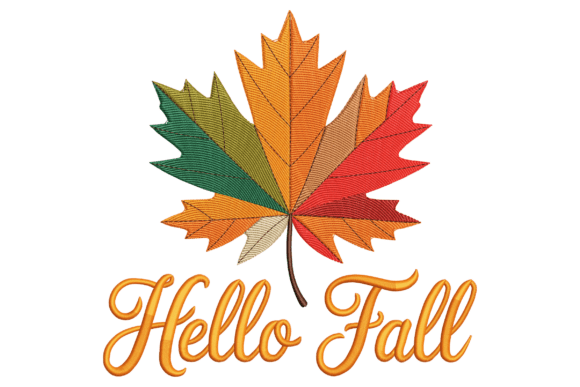
When I opened Modern Hello Fall Maple Leaf, I didn’t see just another autumn motif—I saw a design that breathes intention. The maple leaf isn’t fussy or overly ornate; it’s boldly segmented with clean negative space between panels, giving it architectural presence. That “Hello Fall” text sits low and grounded—not tucked under the leaf, but anchored beside it like a quiet greeting. It feels contemporary without leaning into trendiness, which means it won’t look dated by next October. As a designer who regularly sources embroidery files for client projects and small-batch merchandise, this balance of warmth and restraint is rare—and valuable.
How It Lives on Real Products: From Tote Bags to Baby Onesies
Last week, I stitched Modern Hello Fall Maple Leaf onto a natural canvas tote for a local boutique launch. The leaf filled the lower left quadrant beautifully—large enough to read at arm’s length, detailed enough to hold interest up close. On medium-weight fabric with light tear-away stabilizer, every panel held its shape. No puckering. No thread nesting. The satin stitch edges on the leaf veins stayed crisp, and the fill stitches laid evenly across each segment. That’s not guaranteed with every machine embroidery design—but here, it delivered.
I also tested it on a soft cotton baby onesie (using cut-away stabilizer and reduced density). The result? Gentle, breathable, and undeniably sweet—perfect for a personalized holiday gift. Customers respond well to designs that feel handmade *and* intentional, and this one walks that line: the leaf has personality, but the execution stays professional. For Etsy sellers offering custom sweatshirt embroidery, it scales cleanly to chest placement on midweight fleece. For craft fair vendors making embroidered tea towels, it fits neatly in a 4x4 hoop—no re-hooping required.
Where to Use It Thoughtfully—Not Everywhere
That said, Modern Hello Fall Maple Leaf isn’t a one-size-fits-all embroidery file. Its strength lies in confident scale and clear geometry—so avoid cramming it into tiny hoops or onto highly textured fabrics like bouclé or thick terry cloth. The multi-paneled leaf relies on stitch definition: on dark fabric, make sure your thread colors contrast strongly (especially in the “Hello Fall” lettering—those thin strokes need visibility). On stretchy knits or curved surfaces like caps, use cut-away stabilizer *and* baste first—the leaf’s width can shift slightly if tension isn’t locked down.
The design doesn’t include applique elements, so don’t expect fabric-layering options out of the box. And while the lettering is legible at 3.5 inches wide, going smaller than 2.75 inches risks losing clarity in the “F” and “L” terminals. If you’re planning embroidered patches, confirm the stitch density supports clean edge finishing—some versions of this design pack more fill stitches than others, and dense areas can stiffen lightweight twill backing.
What It Adds to Your Finished Product—Beyond Just Looks
Stitching Modern Hello Fall Maple Leaf elevates perceived value instantly. It reads as curated—not generic. That matters whether you’re selling personalized gifts on Etsy or branding aprons for a local coffee roaster. Customers notice when a design feels cohesive: the leaf’s rhythm echoes the spacing in the typography; the weight of the leaf balances the lightness of the script. That harmony builds trust. A buyer choosing a handmade product wants assurance that the maker paid attention—and this design signals that before a single stitch is made.
For small shop owners, it’s versatile branding fuel: pair it with neutral-toned mockups for social posts, use it on seasonal packaging tags, or layer it subtly into digital embroidery project previews. It works in black-and-white mockups too—no color dependency—which saves time when prepping printable mockups for listings or wholesale catalogs.
Practical Notes Every Embroidery Designer Should Check
- Always test on scrap fabric first—especially if using textured, dark, or lightweight materials.
- Review stitch density before scaling. Some versions of Modern Hello Fall Maple Leaf run denser in the leaf center; adjust if embroidering on delicate baby items or linen.
- Confirm hoop size compatibility. While it fits standard 4x4 and 5x7 hoops, double-check your file’s actual dimensions—some sellers offer alternate sizes.
- Inspect small details at 200% zoom: the inner corners of the leaf panels and the crossbar on the “H” should be fully digitized, not implied.
- Test thread color contrast on both light and dark fabric swatches. Light gold thread pops on navy; charcoal gray reads clearly on cream.
- Use proper stabilizer: light tear-away for stable wovens, cut-away for knits or baby items, and fusible + tear-away for towels or napkins.
- Verify licensing before selling finished products or bundling the embroidery file in digital kits—commercial use rights aren’t automatic.
Final Thought: A Design That Serves Both Maker and Market
Modern Hello Fall Maple Leaf isn’t flashy—it’s focused. It doesn’t shout “fall!”; it invites the season in with quiet confidence. That makes it unusually adaptable: equally at home on a minimalist pillow cover for a modern nursery and a bold sweatshirt for a farmers’ market vendor. As a designer who evaluates hundreds of embroidery files yearly, I keep returning to pieces that simplify decision fatigue for customers while still feeling special. This one does exactly that—without overcomplicating the stitch path, the layout, or the story it tells. If your craft business thrives on clarity, consistency, and seasonal sincerity, Modern Hello Fall Maple Leaf earns its place in your design assets—and on your next real-world embroidery project.