Wildflowers Grow Embroidery Design
A Thoughtful, Faith-Inspired Asset for Small Business Branding
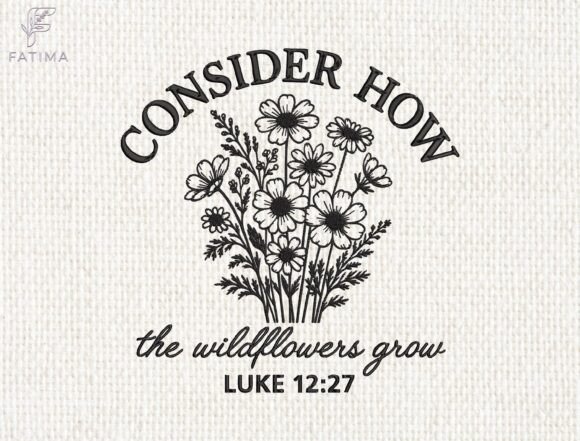
As an embroidery designer who’s developed hundreds of commercial designs for cafés, boutiques, florists, bakeries, and handmade brands, I approach every new machine embroidery design with two questions: Does it serve the brand—and not just the aesthetic? And Will it hold up across real-world merchandise applications? The Wildflowers Grow Embroidery Design immediately stands out—not as a decorative flourish, but as a quiet, confident statement of values. Its roots in Luke 12:27 lend it sincerity and warmth, while its botanical motifs suggest natural beauty, care, and grounded authenticity—qualities small businesses increasingly lean into to build trust.
First Impression: Elegant, Approachable, and Intentionally Understated
At first glance, the Wildflowers Grow Embroidery Design reads as elegant and handmade, not flashy or trend-chasing. It avoids over-engineered flourishes or aggressive typography—instead favoring gentle curves, open spacing, and organic line work. That makes it highly versatile across categories: perfect for a local florist’s apron embroidery, a boutique’s tote bag design, or a pet brand’s chest patch on staff uniforms. It feels premium without being stiff, faith-inspired without being overtly religious—ideal for House Home and lifestyle-focused businesses that want meaning woven in, not shouted.
Real-World Performance Across Merchandise Types
In practice, the Wildflowers Grow Embroidery Design excels where subtlety and storytelling matter most:
- Embroidered patches: Works beautifully at 2.5"–3.5" height—clean outlines hold well, and floral elements retain legibility without excessive stitch density.
- Staff uniforms & aprons: Ideal for left-chest placement or sleeve accents. Its balanced composition avoids visual heaviness, keeping apparel professional yet personable.
- Cap embroidery: Best suited for structured front panels (not curved bill edges). Test letter spacing at 2" width—some script-based phrases can tighten unpredictably on rounded surfaces.
- Tote bag design: Shines on natural canvas or linen. The botanical motif complements unbleached or oat-colored fabric, reinforcing eco-conscious or artisanal brand identity.
- Product packaging accents: A small, stitched version on kraft paper tags or cotton drawstring bags adds tactile credibility to handmade product lines.
- Etsy branding & customer gifts: When paired with neutral thread colors (ecru, sage, charcoal), it signals craftsmanship and intention—key drivers of buyer engagement for creative sellers.
Where to Use Wildflowers Grow Embroidery Design with Care
Like any thoughtful design, it has boundaries—and recognizing them protects your brand’s professionalism:
- Avoid scaling below 1.75": Tiny lettering in “Consider How the Wildflowers Grow” may blur or lose clarity on small patch sizes or cap backs.
- Test on textured fabric: Heavy slubs or loose weaves (like burlap or thick terry) can distort delicate stems or thin script lines—always pair with cutaway stabilizer.
- Dark uniforms need contrast checks: Light-thread versions may fade on navy or charcoal unless stitch density is optimized. Run a black-and-white test first.
- Frequent-wash items demand durability planning: High stitch density in floral clusters should be verified—over-stitching risks stiffness or thread wear over time.
- Curved surfaces require digitizing adjustments: If using on baseball caps or curved tote handles, confirm the embroidery file includes underlay and pull compensation.
How Wildflowers Grow Embroidery Design Strengthens Brand Identity
This isn’t just a pattern—it’s a brand amplifier. When customers see the Wildflowers Grow Embroidery Design on a café apron or bakery tote, they subconsciously register consistency, care, and quiet confidence. That builds customer trust faster than slogans ever could. For Etsy sellers and handmade brands, it elevates perceived value—transforming a simple cotton bag into a meaningful keepsake. Visually, it supports handmade presentation without sacrificing polish, and when used alongside complementary design assets (like matching labels or printable mockups), it reinforces visual consistency across touchpoints—from Instagram posts to physical retail displays.
Practical Designer Notes Before You Stitch
Before ordering or digitizing, here’s what I always verify with the Wildflowers Grow Embroidery Design:
- Test in black and white first: Eliminates color bias and reveals true contrast, spacing, and balance.
- Check small-patch viability: Resize to your most common patch dimension (e.g., 2.25") and inspect letter separation and petal definition.
- Review thread color contrast: Especially on dark or saturated fabrics—what reads softly on white may vanish on charcoal.
- Inspect spacing between words and botanical elements: Tight kerning or overlapping stems can cause nesting issues during stitching.
- Confirm hoop size compatibility: Ensure your standard hoops (e.g., 4x4", 5x7") fully contain the design without re-hooping mid-stitch.
- Test on real fabric + stabilizer combo: A swatch tells you more than any digital preview—check for puckering, thread breaks, or shadowing.
- Create a client-ready mockup: Use the embroidery file in a realistic context (e.g., embroidered on a linen apron photo) before final approval.
- Compare beside existing design assets: Does it harmonize with your logo, fonts, and packaging? Consistency is cumulative.
- Confirm commercial licensing: Since this is intended for small business merch and branded patch use, ensure the digital embroidery file permits commercial embroidery and resale of finished product.
The Wildflowers Grow Embroidery Design doesn’t shout—but it resonates. For small business owners choosing custom apparel, embroidered patches, or branded merchandise, it offers elegance with purpose, beauty with belief, and craftsmanship with clarity. When thoughtfully applied, it becomes more than decoration: it’s a quiet signature of who you are, stitched into everything you make.